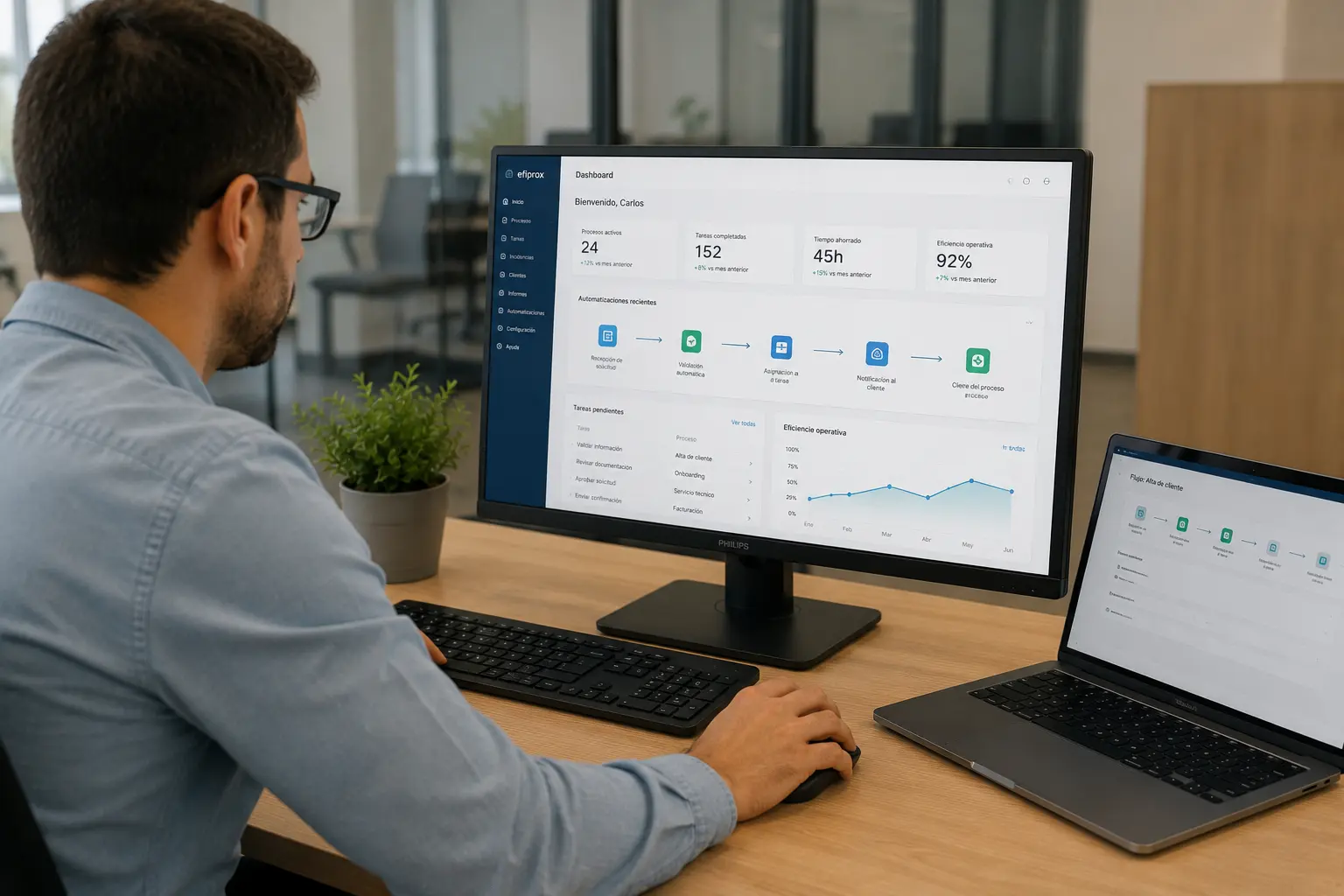
Financial automation should not let a system post entries or release payments without oversight. It should remove repetitive work while keeping decisions, exceptions and ownership visible.
Invoices arriving through different channels, email approvals, data copied into an ERP and outstanding reconciliations belong to one end-to-end flow. Improving a single screen without understanding that journey often moves the bottleneck downstream.
This guide explains which finance processes make good candidates, how to connect them and which controls to design before an automation reaches production.
What financial process automation means
It is the coordinated use of rules, workflows and integrations to carry out administrative and accounting tasks with less manual intervention. A flow may collect documents, validate fields, request approval, record data or compare transactions across systems.
It is not the same as artificial intelligence. Many critical operations are better served by deterministic rules: approval limits, authorised suppliers, cost centres or segregation of duties. AI can help with unstructured input, but it does not replace rules and review.
The goal is not to automate sensitive decisions at any cost. It is to focus the finance team on exceptions that genuinely need judgement.
Finance processes that often make a useful starting point
A strong candidate combines volume, repetition and reasonably stable rules. The following journeys are common, although every organisation must validate its own dependencies.
Invoice capture and entry
A workflow can centralise incoming invoices, check required data, flag duplicates and prepare records for the ERP. Incomplete or uncertain documents should enter a review queue rather than continue as though they were valid.
Expense and payment approvals
Rules can route each request by amount, legal entity, project or owner. The history should show who approved, rejected or changed an item and prevent one person from combining incompatible actions.
Bank and receipt reconciliation
Bank transactions can be compared with invoices or ledger entries using references, dates and amounts. Clear matches proceed; differences, partial payments and grouped payments remain available for a person to resolve.
Recurring close and reporting tasks
Automation can gather data, check that every source has refreshed and raise alerts for deviations. Reports remain trustworthy only when the source and timestamp of each figure are retained.
How to choose the first finance task to automate
Do not begin with the most impressive process. Score each candidate using evidence from current operations:
- Transaction frequency and volume over a representative period.
- Manual effort, waiting time and rework between teams.
- The actual rate and types of exceptions.
- Data quality and the availability of APIs or stable exports.
- The impact of an incorrect run and how easily it can be reversed.
If you need to compare finance with other departments, use our guide to prioritise which business processes to automate first.
A minimum architecture: from document to ERP with traceability
- Controlled intake through email, portal, API or a monitored folder.
- Validation of formats, required fields, duplicates and business rules.
- Orchestration of states, owners, deadlines and approval paths.
- Integration with the ERP, document system and banking tools through authorised interfaces.
- Monitoring through event logs, alerts, safe retries and an exception queue.
When applications do not share identifiers or data contracts, this becomes a business systems integration project.
Controls that should not disappear
A faster process is not an improvement if nobody can explain what happened. Define controls before enabling actions that affect accounting or cash:
- Least-privilege access by role and appropriate authentication in every system.
- Separation between supplier setup, approval and payment execution.
- Amount limits and dual approval where the risk requires them.
- Timestamped records of inputs, changes, decisions and errors, including ownership.
- A contingency plan to stop the flow and continue manually.
Design exceptions as part of the process: owner, available context, deadline and a safe way to resume the flow.
When AI helps and when rules are enough
AI may help classify variable documents, extract fields or suggest a category. A rule is preferable when a condition must always hold and be unambiguous, such as an approval threshold or an exact identifier match.
For a practical decision, review the distinction between artificial intelligence and conventional automation.
A phased implementation plan
- Document the current journey, including normal cases and exceptions.
- Set a baseline and measurable acceptance criteria.
- Build a narrow pilot with representative data and limited permissions.
- Test duplicates, outages, retries and incomplete data before production.
- Roll out by group, monitor outcomes and expand only once the flow is stable.
Track cycle time, exception volume and rework. A high manual-review rate may point to poor data or weak rules; it does not automatically mean the automation opportunity is invalid.
Turn a manual finance workflow into an assessable project
Efiprox can examine the journey across documents, people and systems, then frame an automation with a defined scope, controls and integrations.
Consideration stage
Compare options and choose the next step with clarity
If you are already evaluating solutions, we can help you prioritize impact, timelines, and fit with your real processes.
Frequently asked questions about financial automation
Which finance process should be automated first?
Usually a frequent, repetitive process with sufficiently reliable data and understood exceptions. Invoice capture, approvals or reconciliation may qualify, but the real workflow should be measured first.
Does financial automation require artificial intelligence?
No. Rules and integrations solve many processes more predictably. AI helps with variable inputs such as document classification or extraction when controls match the risk.
Can automation integrate with an existing ERP?
It depends on the ERP interfaces and data quality. APIs, connectors or file exchanges can all work when versions, duplicates, failures and retries are controlled.
What happens when invoices or payments do not match?
They should enter an exception queue with enough context for review. The workflow must define the owner, deadline and a way to resume without creating a duplicate.
How do you measure whether the automation works?
Compare cycle time, throughput, exceptions, errors and rework with a baseline. Include control indicators rather than measuring speed alone.