
Many companies reach the same point without realizing it.
They start using an ERP because it covers most of their needs. For a while, it works perfectly.
But as the company grows, new processes, departments, integrations, and needs appear that were not planned for. Parallel Excels start, emails to complete tasks, manual processes, and improvised workarounds.
Then a very common question arises: do we keep adapting to the ERP, or is it time to develop custom software?
There is no universal answer. It depends on how your company works and what goals it has in the medium and long term.
In this article we will not tell you that custom software always wins. We will help you understand the real differences, when a standard ERP is still the best option, and when it is worth considering something custom —or combining both.
What is an ERP and what is it designed for
An ERP is not an IT concept. It is a business tool designed to centralize and manage the most common processes in a company.
In practice, an ERP is meant to cover areas such as:
- Purchasing and procurement
- Sales and invoicing
- Warehouse and inventory
- Accounting and finance
- Production (in industrial companies)
- Human resources and payroll
An ERP tries to adapt to thousands of different companies.
That has clear advantages: proven processes, relatively fast deployment, and a lower initial cost than building from scratch. If the way you work is similar to most companies in your sector, an ERP may be exactly what you need.
What is custom software
Custom software is a solution designed to solve the specific processes of one company. It does not try to serve the whole market. It tries to serve one organization —yours— with its quirks, exceptions, and way of working.
Custom software does not try to solve every company's problems. It is designed to solve one company's.
It can be a client portal, an operations dashboard, a document management tool, a production traceability system, or a platform that connects the ERP with the rest of the tools you already use.
If you want to go deeper on when this path makes sense, we cover it here: custom software: when it is worth developing a tailored solution.
The real differences between an ERP and custom software
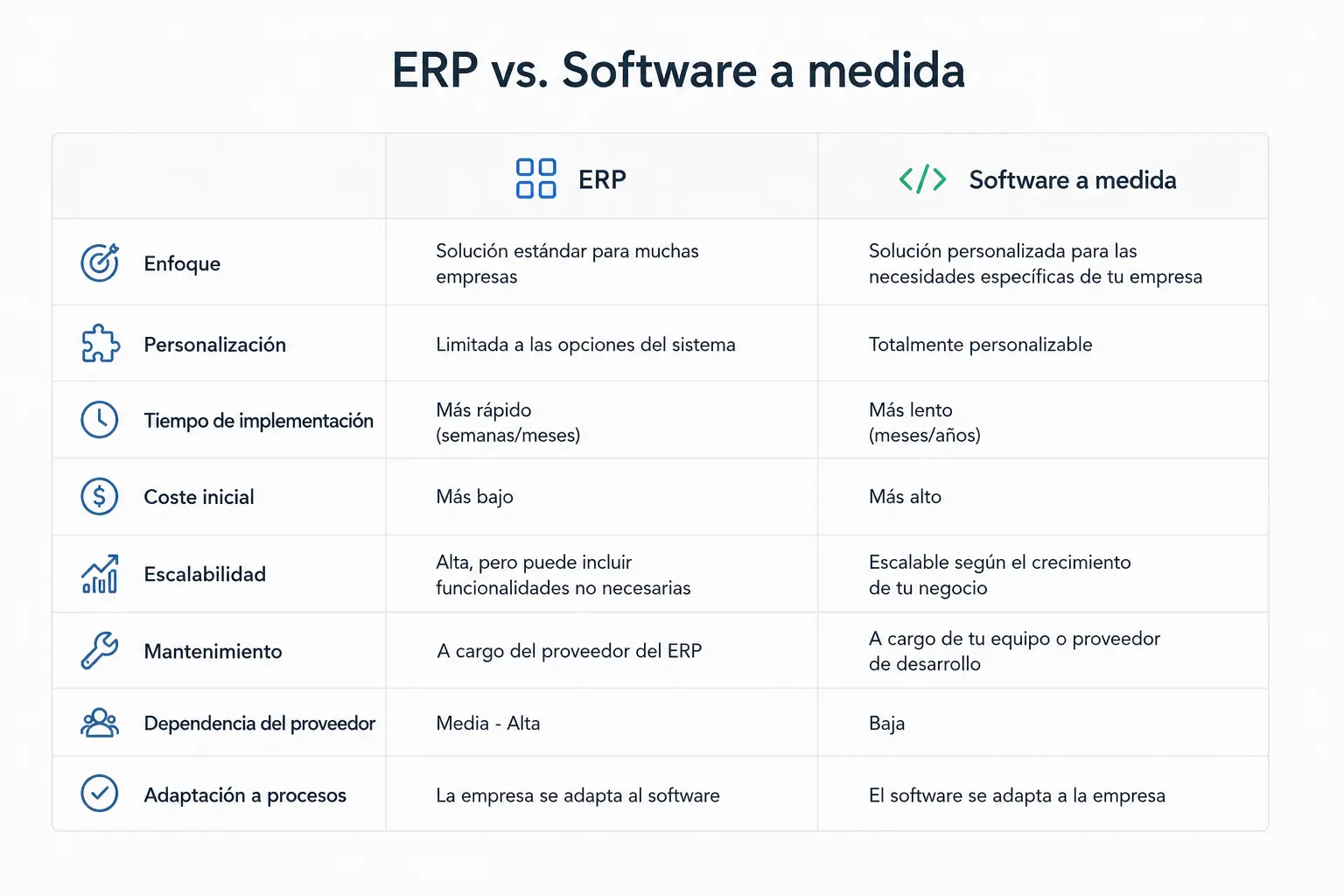
The comparison is not "good vs bad." It is "generic vs specific." And each has its place.
| ERP | Custom software |
|---|---|
| Standard processes | Own processes |
| Fast deployment | Progressive development |
| Generic features | Specific features |
| Limited customization | Full customization |
| Vendor dependency | Evolution based on needs |
| Lower initial investment | Higher initial investment, but more control |
1. Standard processes vs own processes
An ERP assumes your company buys, sells, invoices, and manages stock in a recognizable way. If your operations have steps that do not fit —for example, an approval flow with three different levels depending on client type, or traceability the ERP does not support— you start compensating with Excel, emails, and manual work.
2. Fast deployment vs progressive development
An ERP can go live in weeks or a few months. Custom software requires analysis, design, and development. But that time is not wasted: it is invested in building something that fits from the start, instead of forcing later adaptations.
3. Generic features vs specific features
The ERP gives you out of the box what 80% of companies need. Custom software gives you exactly what your company needs —no more, no less. If the missing 20% is where your competitive advantage lives, the difference matters.
4. Limited customization vs full customization
Configuring an ERP has limits. Some things can be parameterized; others cannot. With custom software, the limit is set by the business, not the product. That does not mean everything is worth customizing; it means you can decide what is and what is not.
5. Vendor dependency vs own evolution
With an ERP you depend on updates, the roadmap, and the vendor's decisions. With custom software, you evolve based on your priorities. That gives control, but also responsibility: someone has to maintain and improve it.
6. Initial investment
An ERP usually costs less upfront. Custom software requires more initial investment. But if you spend years adapting the business to the software —with manual work hours, errors, and rework— the real cost of the ERP can end up higher than expected.
When an ERP is the best option
Saying this honestly builds trust. And it is true: there are companies for which a standard ERP is the right decision.
- Small or medium company with recognizable sector processes
- Need to deploy quickly and start operating
- Low customization needs: the standard covers 90% of what you do
- Tight budget with no room for custom development
Not every company needs to develop its own software.
If you recognize your company in these points, an ERP may be the right solution. No need to overcomplicate it.
When custom software is worth it
This is where custom software for companies starts to make a lot of sense. Not because it is trendy. Because of real need.
Highly specific processes
The way you produce, manage orders, or serve clients does not look like other companies in your sector. You have tried configuring the ERP and there is always a "but we do this differently."
Many integrations
You have ERP, CRM, warehouse tools, supplier platforms, and three "official" Excels. Each system does its part, but nobody tells the full story. You need something that connects everything without someone copying data by hand every day.
Advanced automation
You want certain flows to run on their own: approvals, notifications, document generation, synchronization between systems. The ERP can do part of it, but the rest lives in emails and spreadsheets.
Integrated AI
You need to classify documents, prioritize incidents, summarize information, or detect patterns. AI does not replace the ERP, but it can integrate better in a solution designed for your data and processes.
Scalability
The company grows and the ERP falls short. Adding modules, plugins, or patches each time costs more and the system becomes fragile. Custom development can grow with you in a more controlled way.
Competitive advantage
There are processes that set you apart. If those processes live outside the main system —in Excels, emails, or improvised tools— you are losing control and speed against competitors.
The mistake many companies make
It is not choosing wrong between ERP and custom software. The most common mistake is another: continuously adapting the business to the software.
Changing how you work because the system does not allow otherwise. Adding manual steps to compensate for limitations. Creating parallel Excels nobody wants to touch but without which the company cannot function.
When a company changes how it works only because the software does not allow otherwise, it is probably time to rethink the tool.
That mismatch has a cost that is not always visible on the ERP invoice. We explain it in the hidden costs of manual processes in a company.
What if you do not have to choose only one option?
Here is the nuance many articles ignore. In many companies, the best solution is not choosing between ERP and custom software. It is combining them.
A very common hybrid approach:
- ERP for general processes: accounting, purchasing, inventory, invoicing
- Custom software for specific operations: production, logistics, client portal
- Own tool for document management with flows the ERP does not cover
- Automation that connects both worlds without copying data by hand
- AI integrated where information needs to be interpreted
- Integrations with suppliers, clients, and external systems
It is a very realistic situation. You do not need to throw away the ERP to improve. Sometimes you need to build what is missing around it.

How to make the right decision
These questions help guide the decision without needing to be technical:
- Are your processes very different from what is usual in your sector?
- Do you routinely copy information between several applications?
- Do you need to integrate different systems that do not talk to each other today?
- Does the ERP force you to change how you work at key points?
- Do you want to incorporate automation or AI in specific processes?
If most answers are "no," an ERP —or improving the one you already have— is probably enough.
If several answers are "yes," it is worth exploring custom software development, at least for the parts that cause the most pain.
If there is a clear "yes" on specific operations but the ERP covers the general side well, the hybrid approach is usually the most sensible.
What role does AI play in this decision
Artificial intelligence does not replace the ERP or custom software. It is a capability that can be integrated into either.
In an ERP, AI usually arrives as vendor functionality: assistants, automatic reports, basic classification. In custom software, you can design exactly where and how to apply it: classifying supplier documents, prioritizing incidents, summarizing client history, or detecting production anomalies.
If the decision includes AI, these articles fit well: how to implement artificial intelligence in a company and AI vs automation: real differences.
Practical case
Imagine a distribution company that has grown over the last three years. It started with an ERP covering invoicing and stock. It worked.
Before:
- ERP for general management and invoicing
- Three Excels for route planning, delivery incidents, and returns control
- Emails to coordinate between warehouse, delivery, and customer service
- Manual processes to cross information between systems
After analysis, they chose a hybrid approach:
- Keep the ERP for accounting, purchasing, and invoicing
- Develop a custom operations dashboard for routes, deliveries, and incidents
- Automate synchronization between the dashboard and the ERP
- AI to classify supplier documents and prioritize incidents
Results (no made-up percentages):
- Fewer manual tasks copying data between systems
- Better control over operations that used to live in Excel
- Better traceability of orders, deliveries, and incidents
How we work on these projects at Efiprox
We do not start by selling custom software. We start by listening to how you work.
Our process, in short:
- We analyze processes and detect where time is lost
- We identify limitations of the ERP or current tools
- We assess whether an ERP is enough or something more is needed
- We design only what delivers real value
- We integrate with existing systems (ERP, CRM, etc.)
- We evolve the solution based on business needs
There are companies for which a standard ERP is the best option. And others for which developing custom software ends up being much more cost-effective. Our job is to help you know which is your case.
If you are at that point —growing, with more processes, and wondering whether to keep adapting to the ERP or consider something custom— we can help you decide with sound criteria.

Keep exploring the software cluster
This article is a decision point within the business software cluster. To go deeper:
custom software: when it is worth developing a tailored solution, how to digitize a company step by step, how to implement artificial intelligence in a company, AI vs automation: real differences, what is software and its types, the hidden costs of manual processes, how to choose a software development company, which processes to automate first.
Consideration stage
Compare options and choose the next step with clarity
If you are already evaluating solutions, we can help you prioritize impact, timelines, and fit with your real processes.
Frequently asked questions
What is the difference between an ERP and custom software?
An ERP is a standard solution designed to cover common processes for many companies (purchasing, sales, accounting, warehouse…). Custom software is built to solve the specific processes of one company. They do not compete: sometimes they complement each other.
Which option is more economical?
In the short term, an ERP is usually cheaper. In the long term, if the ERP forces manual work, parallel Excels, and constant business adaptations, the real cost can exceed that of well-planned custom development. It depends on the case.
Can an ERP be combined with custom software?
Yes, and it is one of the most common and sensible approaches. The ERP manages the general side (accounting, purchasing, inventory) and custom software covers specific operations, integrations, or automations the ERP does not handle well.
When is it worth developing your own software?
When processes are highly specific, there are many integrations, the ERP forces you to change how you work, or you need automation and AI at specific points that standard solutions do not cover well.
Can custom software integrate AI?
Yes. In fact, custom software usually offers more flexibility to integrate AI exactly where it adds value: document classification, incident prioritization, automatic summaries, or pattern detection.
Is it possible to integrate custom software with an existing ERP?
Yes, and in most projects it is recommended. You do not need to replace the ERP. You can build a layer that connects to it, syncs data, and covers what the ERP does not do well.