
At the beginning, almost everything fits. An ERP for general management. A CRM for sales. A spreadsheet for certain tasks. Email for sending documents. And a few more tools to cover specific needs.
Nobody necessarily chose badly. It is normal when a company starts: each area solves its part with what is available, and at first it works.
Little by little, small frictions appear. Information has to be copied from one system to another. Some processes stay manual even though “we already have software.” The team loses time on tasks that repeat every week. And each new change—a client asking for another format, an internal process evolving—seems to require another tool, another patch, or another person who “keeps it in their head.”
That is when many companies ask the same question: does it make sense to keep adapting to the software we use… or do we need software that adapts to us?
If you got here after reading about digitization, automation, or the cost of manual work, you probably already know there is a problem. What may be less clear is whether the answer is to build your own software. This article is about that. Not about selling you a project. About helping you understand when custom software for companies truly makes sense—and when it does not.
What custom software really is
Let us be concrete, without language or architecture jargon.
Custom software—tailored software—is a tool designed specifically to solve the way your company works. It is not “another market product with your logo on top.” It is a solution born from your processes, rules, exceptions, and way of making decisions.
It is not about having different software. It is about having software that fits your processes.
That can be an internal platform to manage orders with a flow no standard ERP covers. A panel where sales, operations, and admin see the same information without copying it. A web application that connects what today lives across spreadsheets, email, and WhatsApp.
Custom software development does not start by writing code. It starts by understanding what hurts day to day and what should happen automatically, visibly, and repeatably. If you want the conceptual base before deciding, our guide on what software is and its typesexplains it without jargon.

Why many companies reach the same point
It is not bad luck. It is almost an unwritten law of growth.
When the company is small, flexibility compensates for the lack of system. Maria knows where everything is. Peter sends the email with the right attachment. If an extra spreadsheet is needed, it is created and that is it. Everything works.
When volume grows—more clients, more orders, more people, more exceptions—what used to be “how we work” becomes a bottleneck. What worked with three people starts failing with twelve. What was solved with a WhatsApp message now gets lost between threads.
- Each area chose its tool at a different time, without thinking about the whole.
- Processes evolved, but software did not follow.
- Manual shortcuts appeared that nobody documented because “it has always been done this way.”
- Hiring more people does not fix the process: it only multiplies the same work.
Many companies do not have a team problem. They have a fit problem between how they work and the tools they use.
If this sounds familiar, you are not alone. It is the point where many organizations start looking at custom software development not as a tech whim, but as a way to regain control.
Signs your company needs custom software
You do not need to tick all seven boxes. With several of these signs, it is already worth asking whether a tailored software solution can give you back hours, clarity, and room to grow.
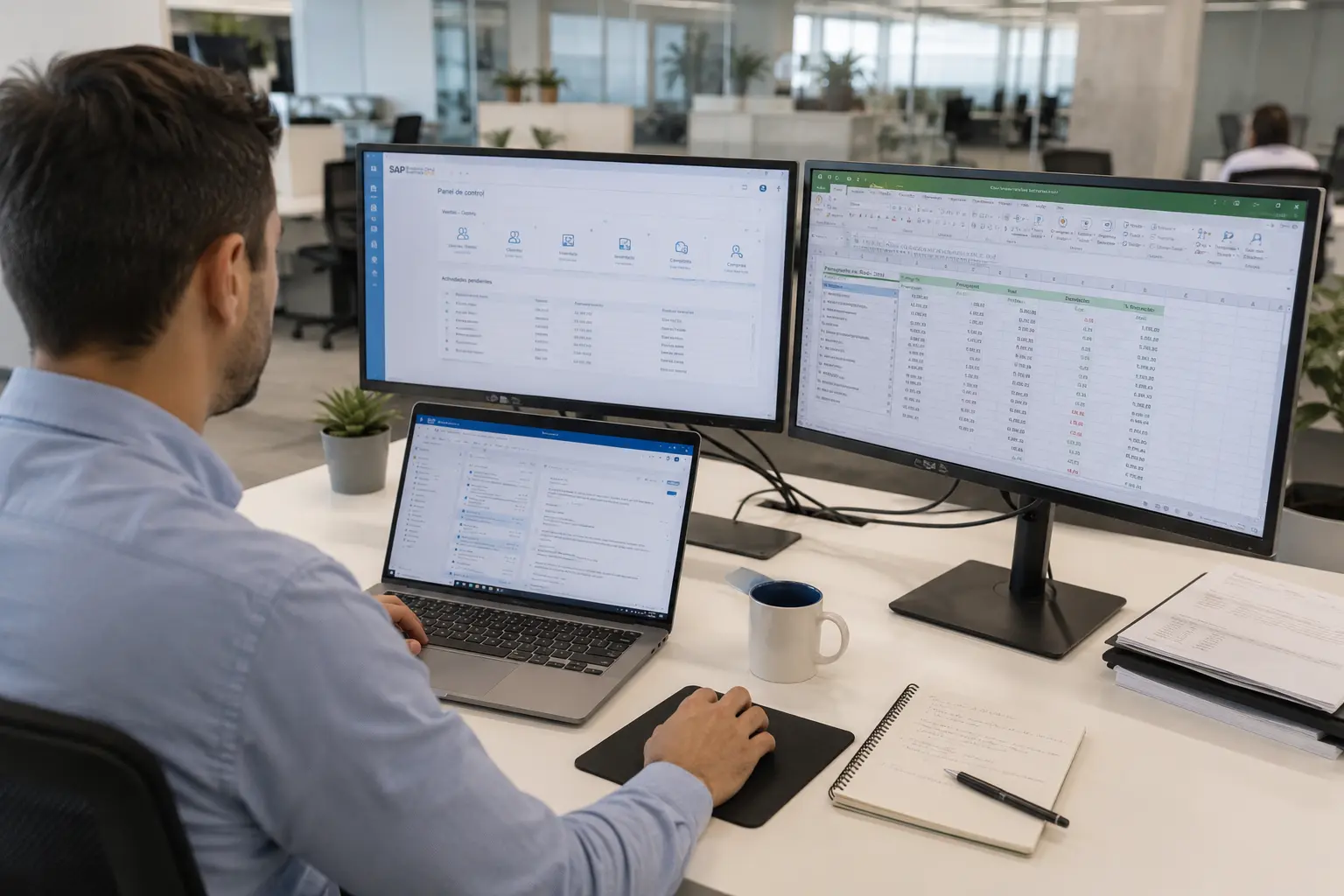
You use too many different tools
You have ERP, CRM, three “official” spreadsheets, two more from “Laura’s team,” Trello for one thing, email for another, and some SaaS contracted two years ago that nobody remembers why. Each program does its part. None tells the full story. When someone new joins, onboarding is: “ask Laura.”
You copy data constantly
The same data lives in three places and someone updates it manually every morning. If a field changes on the order, an email has to warn admin to reflect it in their sheet. That is not “lack of discipline.” It is a broken process someone is patching with human time.
Processes depend on specific people
If a key person is away, the flow stops. Not because the rest do not want to work, but because knowledge lives in conversations, not in a system. That creates stress, bottlenecks, and real risk if that person changes role or leaves.
Current programs do not do exactly what you need
You tried configuring the ERP. You looked at plugins. You added columns to the spreadsheet. And there is always a “but we do this differently.” When adapting the standard tool costs more than designing something that fits, custom software for companies starts to make sense.
There are too many manual tasks
Generating reports by copying data. Searching for the last email with the right quote version. Creating the same document with different names every week. If the team spends hours on mechanical work, the problem is usually not motivation: the process forces you to work as if there were no technology.
If you want to go deeper on what that invisible work costs, we recommend reading about the hidden costs of manual processes in a company. Sometimes seeing the hours helps you decide.
Every change costs a lot of money
You want a new field, a different flow, an integration with another tool… and each request becomes an external project, vendor consulting, or “not included in the license.” If your business changes faster than your software, you pay twice: the license and the friction.
The company keeps growing
Each new client means the same manual dance. Each project multiplies coordination hours. You cannot keep going without more people, but hiring only worsens the mess if the underlying process does not scale. Here custom software is not luxury: it is infrastructure to grow without everything becoming more complex.
Companies do not need custom software as a trend. They need it when standard software no longer solves problems the business carries every day.
When custom software is NOT worth it
Saying this matters. Not every company needs a tailored solution. And that is fine.
- Very small company with simple processes and low volume: existing tools well chosen are often enough.
- Standard market process: if you do the same as thousands of companies, mature SaaS is usually cheaper and faster.
- Very tight budget with no room to maintain evolution: poorly maintained custom development can become obsolete quickly.
- Temporary project or short-lived pilot: if the process will disappear in six months, building your own platform may not pay off.
- The process is still unclear: automating or digitizing chaos only makes chaos faster.
Not every company needs custom software. And that is fine.
In many cases the path goes first through knowing if your company needs to automate processesor ordering operations with tools that already exist. Custom software comes in when the difference is in how you work, not only how much you work.
Real advantages of custom software
Forget generic PowerPoint lists. These advantages show up in day-to-day work, not in a brochure.
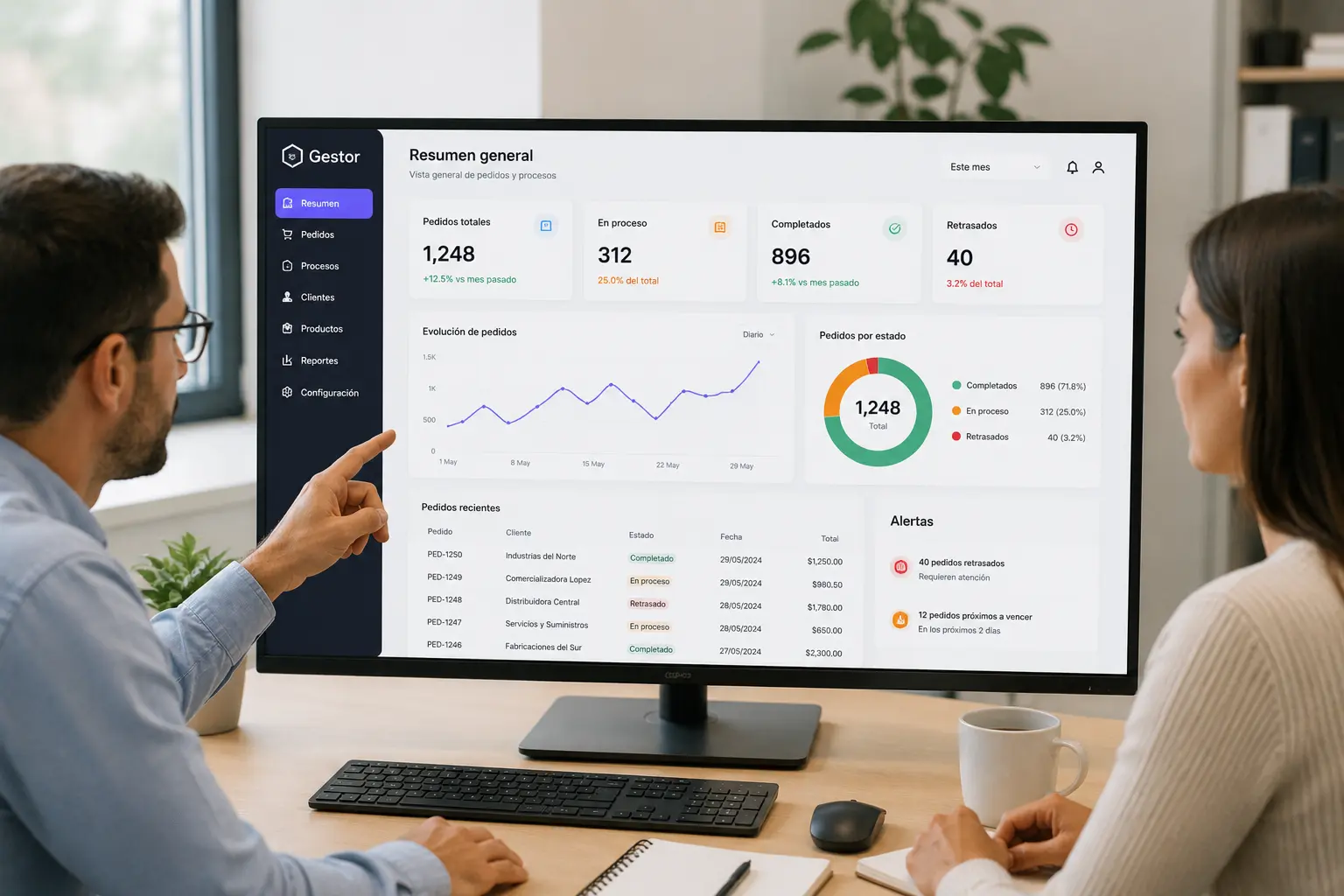
Fit with the business
A quote approval flow can have three levels on Tuesdays and two on Fridays if that is how you work. Standard software will say that “cannot be done.” Custom software reflects it. The tool stops fighting operations.
Scalability on your terms
You start with a module that hurts today—orders, incidents, reports—and grow in phases. You do not pay for a hundred features you do not use. You add what the business asks for when it asks.
Automation where it really matters
When the system knows your steps, it can notify, assign, validate, and log without anyone copying anything. It is not magic: it is design. And it usually starts by removing the repetitive work that eats the most hours.
Integrations that connect what you already have
You do not always have to replace the ERP. Sometimes you need a layer that talks to it, to the CRM, and to that spreadsheet that “cannot be touched.” Custom development can join pieces without forcing a big bang.
Greater control
You decide what data is stored, who sees it, how the tool evolves, and what priority each improvement has. You do not depend on a generic vendor roadmap that does not know your sector.
Better experience for the team
Screens designed for whoever uses them eight hours a day. Fewer clicks. Less “where was that?” When the tool fits, the team stops complaining about the program and goes back to complaining about the usual things—which is already a win.
Independence from manual processes
The goal is not to remove people. It is for them to stop being the glue between systems. For knowledge to live in the process, not only in two key people’s heads.
Standard software vs custom software
Neither is better in the abstract. There is one that fits your moment and way of working.
| Standard software | Custom software |
|---|---|
| Generic processes | Adapted to the business |
| Common market features | Features specific to your operations |
| Scalability limited to what the product offers | Scalability based on your real needs |
| Dependence on external updates and roadmap | Evolution controlled with you |
Many companies end up hybrid: SaaS where the process is commodity and a custom layer where you truly compete. The question is not “all or nothing.” It is where each fits best.
How to know if it is time to take the step
If you tick several of these, you do not have to launch a huge project tomorrow. It is a sign that an honest analysis—even of two or three flows—is worth it before keeping on patching.
- The team loses time every week on tasks that repeat the same way.
- There are frequent errors from copying data or outdated versions.
- There is duplication: the same information in several places without syncing.
- Everything depends on spreadsheets for something that should be in a system.
- There are hard-to-control processes: you do not know the status without asking.
- Every improvement in current tools is expensive, slow, or impossible.
When to develop custom software is not a question of company size. It is fit. If the pain is recurring and the process can be described, there is already material to work with.
The role of automation and AI inside custom software
Here it helps to order ideas, because they get mixed up a lot in leadership conversations.
- Software → First comes software: a base where your data, states, roles, and operational rules live. Without that, everything else sits on sand.
- Automatización → On that base comes automation: alerts, assignments, validations, connections between tools. That removes mechanical work with clear rules.
- IA → Then AI can come in: classifying requests, summarizing information, detecting patterns, helping decide with data nobody had time to look at before.
Software, automation, and AI do not compete. They complement each other. AI without good data and ordered processes usually frustrates. Automation without software to support it stays patchwork.
If you want to go deeper, these two articles fit very well with this phase: How to implement artificial intelligence in a company y How to know if your company needs to automate processes.
Well-planned custom software leaves the door open to all three layers without forcing you to implement them all on day one.
Practical case: from scattered tools to one solution
Fictional company, very real situation: technical supplies distributor with about thirty employees. They had been growing for years with what they had.
Technical supplies distributor · ~30 employees · steady growth
Before
- ERP for billing and basic stock.
- Spreadsheet to plan routes and deliveries.
- Email to confirm special orders.
- WhatsApp for warehouse urgencies.
- Each manager with their own way of knowing “where” each order is.
After
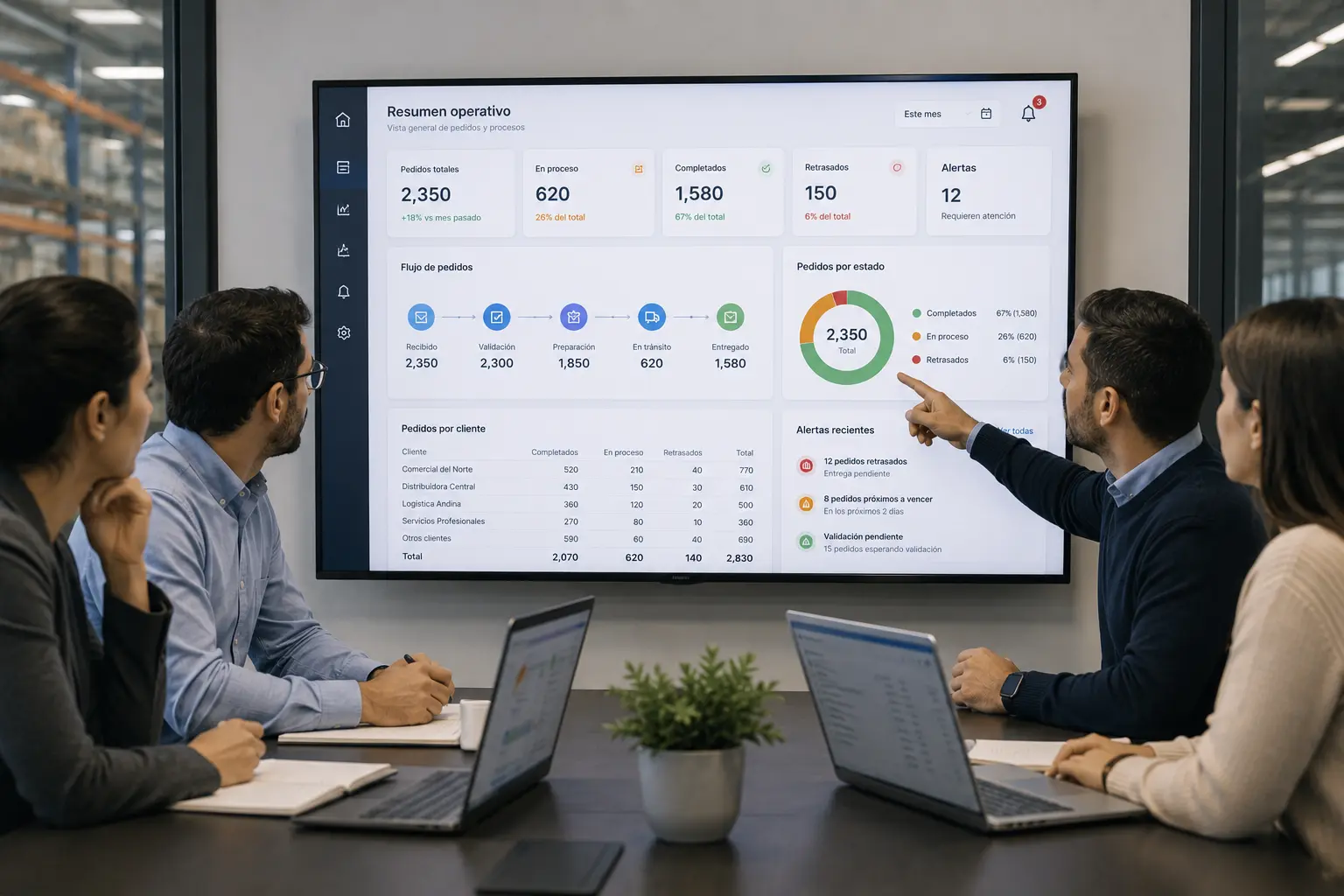
- Single platform where the order enters and its full journey is visible.
- Automated alerts when an order is delayed or stock is missing.
- Dashboards for leadership without waiting for Friday’s report.
- AI layer to classify recurring incidents and suggest priority.
Results (no invented figures)
- Less time searching for information across programs.
- Fewer errors copying data between spreadsheets and ERP.
- More peace of mind when someone is on leave: the process stays visible.
- Base ready to grow without multiplying administrative chaos.
They did not buy “the perfect platform.” They analyzed how they worked, prioritized one flow, and improved it over time. That is custom software development applied to the business, not to a feature catalog.
How we approach a custom software project at Efiprox
We do not start with code. We start by understanding what happens day to day.
Our approach is applied consulting: less sales deck, more awkward but useful questions. What hurts? Who suffers it? What happens if it fails? What would success look like in six months?
- Analyze real processes, not org-chart ones.
- Detect problems and prioritize by impact and feasibility.
- Design a solution the team understands before building it.
- Iterative development: short deliveries, feedback, adjustments.
- Supported rollout, not “here is the manual.”
- Continuous evolution as the business changes.
If the software includes web apps or client portals, it aligns with what we explain in what web development is and why it matters for a company. And if the doubt is whether you need an application or a conventional website, custom website vs WordPressusually clarifies a lot.
We do not sell projects by size. We sell fit. Sometimes the best decision is not to build custom software yet. When it is, we prefer honest scope over an impossible promise.

Keep exploring: the custom software cluster
This article is the decision point. If you want context before or after, these links form a coherent path:
ERP vs custom software: which does your company really need, How to digitize a company step by step, How to know if your company needs to automate processes, The hidden costs of manual processes in a company, How to implement artificial intelligence in a company, How much custom software costs, how to choose a software development company, which processes to automate first, What software is and its types, what web development is and why it matters for a company, custom website vs WordPress.
When you already know it is worth building, the next step is usually choosing a software development company with criteria. And if you are still prioritizing where to improve first, see which processes to automate first. From any of those articles you can come back here when the question is: is it worth building my own software?
Consideration stage
Compare options and choose the next step with clarity
If you are already evaluating solutions, we can help you prioritize impact, timelines, and fit with your real processes.
Frequently asked questions
What is custom software?
It is a tool designed specifically for how your company works: your processes, rules, exceptions, and integrations. It is not a generic product adapted with patches, but a solution born to solve your concrete problems.
When is it worth developing your own software?
When standard tools do not fit your operations, you copy data between systems daily, the process depends on specific people, and every change costs too much. If the pain is recurring and the flow can be described, a serious analysis is worth it.
Is custom software more expensive?
Initial investment is usually higher than a SaaS license. But compare total cost: licenses, lost hours, errors, forced integrations, and limitations. Sometimes what is “cheap” costs a lot every month. In other cases, mature SaaS is the smart option.
How long does development take?
It depends on scope. A bounded first module can be weeks or a few months. A broad platform is built in phases. What matters is starting with a process that has clear return, not an endless project.
Can it integrate with other programs?
Yes, and in most projects it is essential. Custom software usually coexists with ERP, CRM, or other tools, connecting them instead of replacing everything at once.
Can it include artificial intelligence?
It can, when there is ordered data and clear processes. AI adds value on a well-designed base: classify, summarize, detect patterns, or help decide. It does not replace good software design.