
Artificial intelligence (AI) is technology that can mimic certain human-like skills—learning from examples, analyzing large amounts of information, or supporting decisions. You do not need an engineering degree to grasp it: it is software that improves when it receives data and feedback.
Years ago it sounded futuristic; today AI sits inside tools we use daily—recommendations, assistants, chatbots, and business automation. In this guide you will learn what artificial intelligence is, how it really works (without academic fluff), and why it is reshaping entire industries—especially when paired with common sense and a process mindset.
What is artificial intelligence?
In the simplest terms, AI looks for patterns in data and uses them to predict, classify, recommend, or automate actions. It does not “think” like a person; it calculates and adjusts models with math and training.
That is why data quality matters so much: models trained on bad information tend to scale mistakes. In companies the challenge is rarely “having a model”; it is having trustworthy data and responsible use.
What AI tries to do (in plain language)
- Learn: improve as it sees more examples and corrections (like spam filters once you teach what was mislabeled).
- Analyze: scan thousands of rows, texts, or images faster than a human team to summarize or flag anomalies.
- Predict: estimate probabilities (churn, failure risk, demand spikes).
- Automate: run repetitive tasks with learned judgment—not only rigid “if A then B” rules.
AI vs simple automation
Classic automation follows hand-written rules: if A happens, do B. AI generalizes from data: it can handle variations that were never coded line by line. That is why it fits messy text, fuzzy voice, or customer behavior that drifts over time.
Everyday examples you already know
- Recommendations on streaming or ecommerce (“because you watched…”).
- Voice assistants that capture intent, not only isolated keywords.
- Spam filters, assisted translation, or email reply drafts.
How does artificial intelligence work?
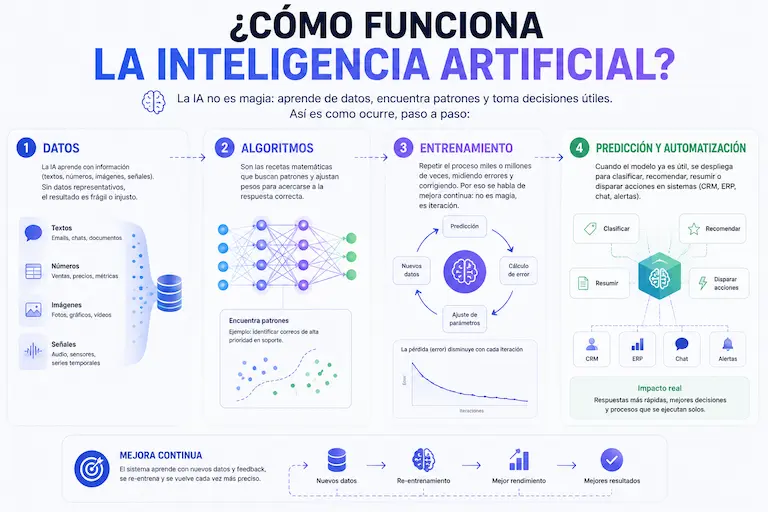
Here is the useful version without turning this into a paper. How AI works, in four pieces you will see in real projects:
Data: AI learns from information—text, numbers, images, signals. Without representative data, results are brittle or unfair.
Algorithms: the mathematical recipes that hunt for patterns and adjust weights to get closer to the right answer.
Training: repeat the process thousands or millions of times, measuring error and correcting. Improvement is iteration, not magic.
Prediction and automation: once the model is useful, it is deployed to classify, recommend, summarize, or trigger actions in systems (CRM, ERP, chat, alerts).
Think of a new warehouse hire: at first they confuse similar boxes; over time they spot patterns from experience. AI does something analogous with data—and limits: it does not understand the world; it optimizes signals.
Types of artificial intelligence
Types of artificial intelligence often come with heavy names. Here is the “business decision” version:
Narrow AI: what exists in real products today. It solves specific tasks—support chatbots, ticket classifiers, recommendation engines. It does not “reason” about everything; it is scoped.
General AI: still theoretical. It would match broad human capability. Useful for context in conversations, not for vendor quotes.
Machine Learning: the branch of AI where systems learn patterns from data without us programming every rule by hand. It powers many prediction and classification projects.
Deep Learning: a kind of Machine Learning with deep networks—very strong for image, voice, or long text. It usually needs more data, compute, and careful deployment.
Examples of artificial intelligence in real life
Examples of artificial intelligence make the topic concrete. These are common and map to what you can implement with solid engineering:
AI in mobile apps
Face unlock, dictation, photo search, smart replies. Pair utility with privacy and clear permissions.
- Camera capture that reads documents and fills fields (with human review).
- Smart notifications based on habits—health, personal finance, logistics.
AI in companies
- Lead prioritization and sales scoring.
- Data extraction from invoices or delivery notes for finance teams.
- Internal assistants over documentation—with traceability and permissions.
AI in cybersecurity
Anomaly detection, malware signals, fraud patterns. Adds speed but still needs human processes and data governance.
AI in automation
AI-powered automation blends rules with learned judgment—routing requests by tone and history, not only by a dropdown field.
AI in customer service
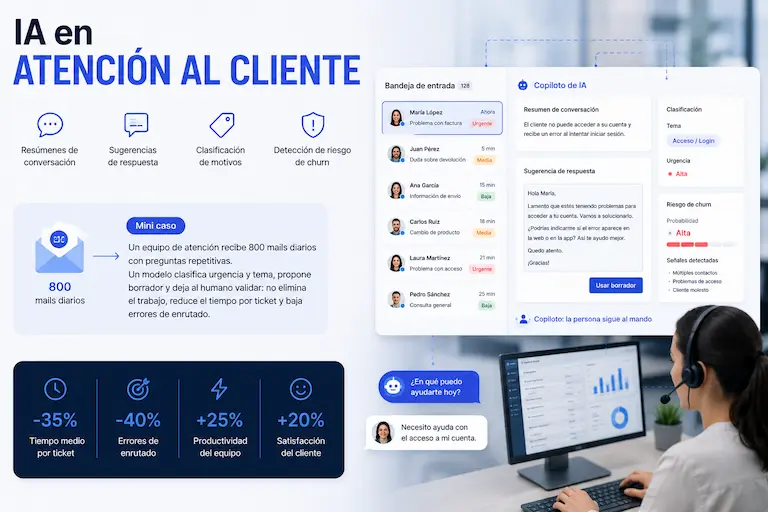
Conversation summaries, reply suggestions, intent tagging, churn risk hints. Copilots work best: humans stay accountable.
Mini case: A support team gets 800 repetitive emails daily. A model classifies urgency and topic, drafts replies, and humans validate: it rarely removes the job; it cuts time per ticket and routing mistakes.
| Classic automation | Artificial intelligence |
|---|---|
| Hand-written rules (if A, then B) | Learns patterns from data and tolerates variation |
| Easy to explain, rigid when the business changes | More flexible, but needs data, governance, and maintenance |
What is artificial intelligence for?
What AI is for is best answered with measurable benefits—not hype. In business it usually helps to:
- Save time on repetitive tasks (triage, classification, first responses).
- Reduce human error at high volumes of data or text.
- Analyze data faster and surface signals spreadsheets hide.
- Improve decisions with predictive support—always with supervision and ethics.
- Scale operations without growing headcount at the same pace—especially in support and back office.
How artificial intelligence is transforming companies
AI in business is not a marketing sticker: when it fits, it changes pace and cost. Areas where we see the strongest ROI:
Customer service
Shorter waits, more consistent answers, better intent detection. AI does not replace empathy; it frees time for hard cases.
Process automation
CRM/ERP integrations, smarter workflows, less copy-paste across systems. This connects directly to automation with AI and solid data design.
Prediction and analytics
Demand, inventory, default risk, predictive maintenance. The win is moving from late reports to actionable alerts.
Cost reduction
Not always “cut people”; often it cuts rework, returns, or idle time between departments.
Productivity
Teams stop losing hours on mechanical tasks and can focus on sales, quality, or innovation.
AI does not replace companies—it multiplies the capacity of those that use it with data, processes, and training.
Myths about artificial intelligence
Debunking myths improves decisions and keeps the tone human. A few classics:
- “AI will do everything alone tomorrow”: in practice you need goals, data, validation, and owners.
- “AI thinks like a human”: no consciousness; it predicts and optimizes patterns.
- “Only big companies benefit”: many SMEs start with internal copilots, classification, or document extraction.
- “Drop in ChatGPT and we have enterprise AI”: the tool is a start; value is in process, integration, and governance.
- “It is neutral because math”: bias comes from data and design—audit both.
Risks and challenges of artificial intelligence
Talking about risks builds authority (EEAT) and avoids naive projects. The most common audit themes:
- Privacy: personal data, retention, usage boundaries; compliance and transparency with customers and employees.
- Bias: unfair decisions when history encodes discrimination or data is incomplete.
- Dependency: operational risk if nobody understands the model or the vendor.
- Security: prompt injection, data leaks, or attacks on systems wired to models.
None of this should paralyze you: it is a risk map managed with design, policies, and periodic review.
How can a company start using AI?
To implement AI without overwhelming the team, skip giant models on day one. Start with the boring (high ROI) stuff:
- A list of high-volume, low-risk-if-wrong repetitive tasks for pilots.
- Minimum viable data: where it lives, who maintains it, and its quality.
- A copilot or assistant with human review—not fully automated critical decisions on day one.
- Integration with one or two tools you already use (CRM, helpdesk, ERP) to avoid another silo.
- Simple metrics: time per task, error rate, internal satisfaction. If it is not measured, it does not improve.
How to implement artificial intelligence in a company
A short, realistic path from curiosity to a grounded project:
- Spot repetitive processes with clear pain (delay, cost, or quality).
- Analyze available data and gaps; without this there is no serious model.
- Pick tools and approach (assisted, batch, API integration) based on risk and maturity.
- Integrate systems and workflows; isolated AI creates frustration.
- Train people who validate and correct; without human feedback models degrade.
- Scale in phases with security, cost, and compliance checkpoints.
Looking to implement artificial intelligence in your company?
The point is not to use AI because it is trendy, but to apply it where it truly moves the needle: less friction, better data, faster decisions.
If you want to land concrete cases in your operations, we can start with an audit or a process analysis to see fit, risks, and priorities.
Keep reading (helpful links)
This guide is an AI pillar page—use it as a map and jump to deeper resources when needed.
We recommend combining these links with your next question: how to implement artificial intelligence in a company, how to digitize a company step by step, Artificial intelligence for business (service), How to know if your company needs to automate processes, Process automation, Custom software cost (includes AI-heavy projects), Artificial intelligence guides, Goals and digital transformation, Web development, Custom software development.
Awareness stage
Keep exploring with a practical guide
If you are still mapping the problem, we help you move from concepts to an actionable plan for your company.
Frequently asked questions about artificial intelligence
What is AI in simple words?
Software that learns patterns in data to predict, classify, recommend, or automate tasks—usually with supervision and clear boundaries.
How does an AI learn?
With training data and algorithms that adjust the model to reduce error; then validate on fresh data and with humans fixing edge cases.
What is the difference between AI and Machine Learning?
AI is the broad concept; Machine Learning is one way to achieve AI by learning from data without hand-writing every rule.
Can a small company use AI?
Yes, starting with scoped tasks—classification, document extraction, or internal copilots. Governance and realistic expectations matter most.
Will AI replace jobs?
It tends to change tasks more than erase whole roles: it automates repetition and pushes people toward higher-value work. Impact depends on sector and training.