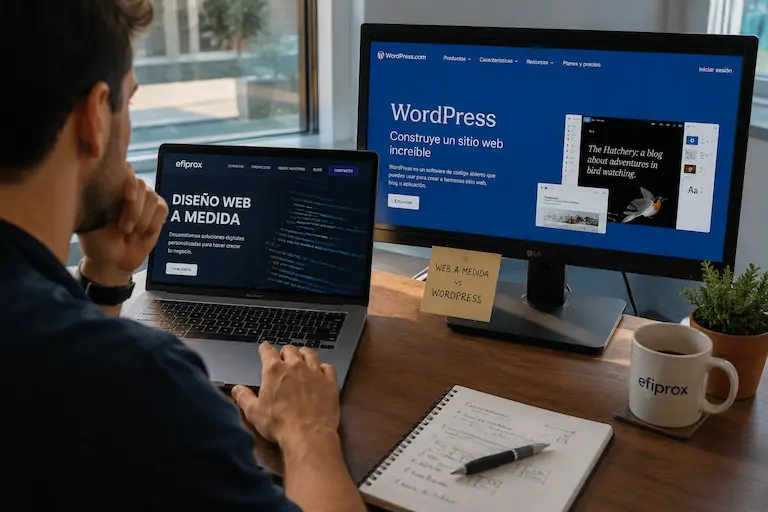
Web development is how teams create and maintain websites and web applications where companies and customers meet, buy, and get things done online. You do not need to be technical to understand the basics: most journeys start in a browser.
A website is no longer just a brochure: it can become a system to attract clients, reduce manual work, and support growth. In this guide you will learn what web development is, what it is for in real business life, the main types, and why many teams treat it as an investment—not a line item to minimize.
What is web development?
In simple terms, web development combines content, design, and engineering so a site or web app works reliably: fast loads, clear usability, and a measurable goal (sell, inform, support, manage data, and more).
Behind the scenes there is programming, databases when needed, security, accessibility, and architecture decisions—but from a business view the outcome matters most: a stable experience people understand and trust.
It also includes maintenance: measuring, improving, and adapting when your offer, processes, or customer expectations change.
What is web development for?
If you are asking what web development is actually for beyond “being online”, think visibility, efficiency, and growth. These are the use cases that usually return the most value.
Acquire clients and build trust
Professional web development helps you show up when people search for you, explain what you do with clarity, and reduce friction on first contact (short forms, proof points, helpful content).
- Better visibility when the site structure supports SEO and answers real buyer questions.
- More trust with clear copy, social proof, performance, and accessible navigation (logical headings, contrast, visible focus states).
- More pipeline when the site connects to your CRM so follow-up does not depend on scattered inboxes.
Automate processes and reduce manual work
This is where many companies unlock real value: the website stops being a leaflet and becomes an operational channel.
- Smarter forms and validation to prevent common errors (missing fields, duplicates, bad data entry).
- Integrations with tools you already use: CRM, ERP, payments, booking, or e-signatures.
- Reservation flows, customer onboarding, or internal requests that used to live in email and spreadsheets.
- Private areas so sales and operations teams work from the same up-to-date information.
Improve internal productivity
When information is centralized and flows are explicit, teams spend less time on repeated questions and copying data between tools.
- Fewer repetitive admin tasks: less spreadsheet juggling, fewer forwards, fewer “which version is true?” moments.
- More focus on selling, serving, or producing because the site supports predictable admin work.
Scale the business with a digital foundation
If leads, orders, or users grow, you need a foundation that handles peaks and can evolve without rebuilding everything every year.
- Digital processes you can expand in phases (new service, new market, new integration) without breaking what works.
- Performance and technical SEO as multipliers: a slow or confusing site hurts rankings and conversion alike.
Types of web development
Not every website is the same; knowing the common types of web development helps you choose the right approach—in business language, not as a programming manual.
Frontend development (what people see)
What users see and tap: layout, visual hierarchy, perceived speed, and microcopy that guides actions. Strong frontend work improves usability, accessibility, and conversion.
Backend development (logic and data)
What happens behind the scenes: permissions, validations, databases, APIs, and business rules. Without a solid backend, private areas and forms become fragile or risky.
Full-stack development (end-to-end thinking)
Combines frontend and backend with product judgment: align UX with data, performance, and maintainability. Especially useful for medium and large initiatives.
Custom web development (when templates stop fitting)
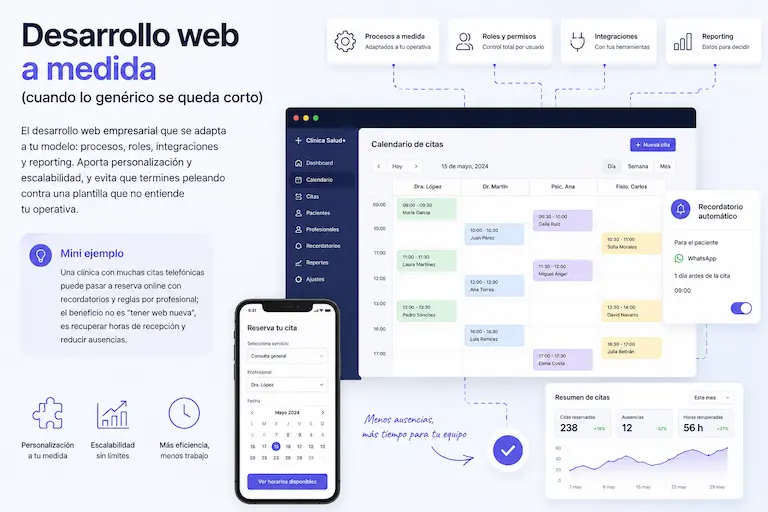
Tailored web development matches your model: processes, roles, integrations, and reporting. It improves scalability and avoids fighting a template that does not understand your operations.
Mini example: A clinic handling many phone bookings can move to online scheduling with reminders and per-staff rules; the win is not “a new website”, it is reclaimed reception time and fewer no-shows.
Web design vs web development
This is a common search intent—and it deserves a straight answer: design and development overlap, but they are not the same job.
| Web design | Web development |
|---|---|
| Look and feel, brand, visual hierarchy, and tone | Stable functionality, performance, and business rules |
| UX/UI: flows, prototypes, usability, and visual accessibility | Programming, data, integrations, security, and deployment |
In serious projects they should work together: great design without engineering breaks under traffic; perfect engineering with poor UX will not convert.
Why web development is critical for a company
If we summarize the importance of web development in four ideas, they usually match what we see in audits: acquisition, operations, differentiation, and growth.
The website as an acquisition channel
Sales and leads rarely appear by accident: you need a clear value proposition, speed, trust signals, and measurement. A conversion-oriented site connects marketing and sales with traceability.
The website as a business tool
Automation, integrations, and efficiency: less operational friction and fewer human errors on repeatable tasks.
The website as a competitive advantage
When competitors are online too, the winner explains better, responds faster, and makes the next step easier (call, demo, purchase). Customer experience is part of the product.
The website as a scalable asset
A solid foundation supports growth: new services, markets, or volume without rebuilding from scratch every year. That is how you think about the benefits of web development over time.
A website should not be treated only as an annual expense: it can become a tool that produces measurable outcomes (more opportunities, lower operational cost, better data for decisions).
Common mistakes in enterprise web development
If you want fewer surprises, watch for these frequent mistakes; they often explain why a “beautiful” site still underperforms.
- Design-only thinking without performance, accessibility, and SEO structure (headings, internal links, structured data when relevant).
- Slow, heavy sites: they hurt rankings, conversion, and perceived professionalism.
- No conversion focus: weak calls to action, long forms, or generic messaging that does not match search intent.
- Launching without technical SEO basics: indexing, metadata, structured data where appropriate, and coherent content architecture.
- No scalability mindset: you end up with fragile patches, plugin stacks, or duplication that makes every change expensive.
When does a company need custom web development?
Generic solutions can work at the start; as a company grows, it usually needs tools aligned with real processes. Typical signals:
- You still manage orders, incidents, or onboarding with manual workflows that no longer scale.
- Off-the-shelf tools do not fit your rules, permissions, or reporting, so you compensate with extra manual work.
- You need real automation: validations, states, approvals, integrations, and traceability.
- You are growing and need differentiation with your own experience—not the same template as competitors.
If this sounds familiar, the next step is not “pick trendy tech”, but define priorities and a phased roadmap with clear ROI.
How to choose a web development company
If you are evaluating professional web development for companies with intent to hire, use this checklist before signing:
- Real experience with similar industries and company sizes (not only portfolio screenshots).
- Business mindset: they ask about goals, metrics, and processes—not only colors.
- Scalability: sensible architecture and maintenance planning, not shortcuts that hurt later.
- Clear support: response times, evolution plan, and how incidents are handled.
- Technical SEO and performance as requirements, not as a last-minute add-on.
- Transparency on scope, risks, timelines, and total cost of ownership—not only day-one price.
If the project is not just a website, but software, a platform, or an internal app, you should also read how to choose a software development company: the questions shift a bit, but the business criteria stay the same.
Looking for a web development company for your business?
We analyze each initiative from both a technical and strategic angle, aiming for solutions that actually help the business grow.
If you want a first diagnosis, we can guide you with a free audit or a short discovery call to align priorities and fit.
Go deeper (helpful links)
This article works as a pillar page: use it as a hub to jump into more specific reads and related services.
We recommend combining these resources: how to digitize a company step by step, web development agency guide (includes indicative pricing), web development services, custom software development, how to know if you need to automate processes, custom website vs WordPress, process automation, AI for business, goals and digital transformation, why your website is not generating clients.
Awareness stage
Keep exploring with a practical guide
If you are still mapping the problem, we help you move from concepts to an actionable plan for your company.
Frequently asked questions about web development
What does a web developer do?
They translate business needs into a working website or web app: screens, forms, integrations, performance, and security. They also collaborate with design and content so the experience stays coherent.
How much does web development cost?
It depends on scope: a simple corporate site is not the same investment as a platform with integrations, private areas, and automation. A healthy approach is a budget range with explicit assumptions and value comparison—not price alone.
How long does it take to build a website?
A small site can ship in weeks; projects with serious SEO, complex content, or integrations usually run in multiple phases over months. The key is milestone validation, not promises without a defined scope.
What is the difference between a website and a web application?
Both run in a browser. The difference is usually depth: a web application involves more interaction, states, permissions, and data; a website can be more informational. The boundary is often fuzzy and should follow needs.
What is a custom website?
A solution built for your processes and goals, with control over architecture, integrations, and evolution. It is not “code for its own sake”: it is fitting the tool to your operations instead of forcing operations into a rigid template.