Having a website is no longer enough. Many companies invest in their site and still do not get a single client from it. If you have ever asked yourself why my website is not generating clients, you are not exaggerating: it is a real frustration and far more common than it seems.
This article is written to help you spot what is holding your business back, without unnecessary jargon. You will see the web development mistakes that cost money every month and how to fix them to improve website conversions with a clear, human, results-focused strategy.
The reality: having a website does not mean having clients
Being online and selling are not the same thing. You can have a professional domain, a decent design and even get visits, but if the structure is not built for business, the website does not convert.
Many company websites are launched as a closed project: it goes live, everyone celebrates and it is forgotten. The problem is that a website is not a digital brochure; it is an active sales tool that has to attract, persuade and make the next step easy.
When that does not happen, what looks like an asset ends up as a fixed cost. Not only because of the money you invested, but because of all the opportunities that are lost without anyone noticing.
A website without a business focus is not an investment: it is a leak of opportunities.
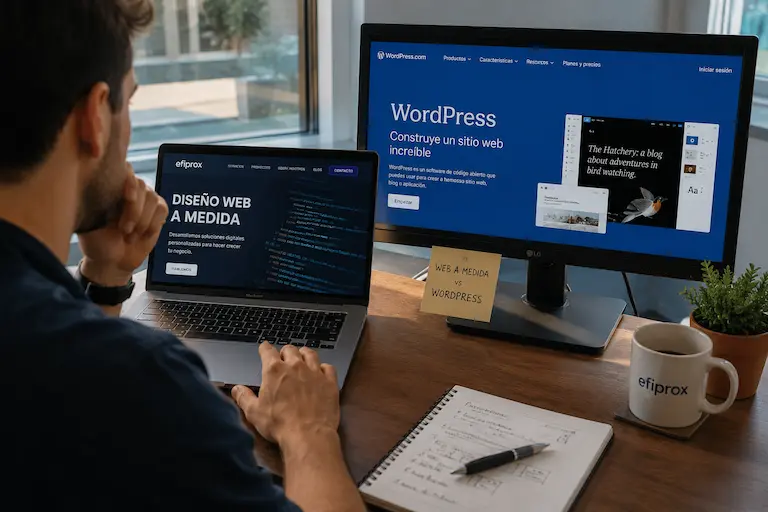
To go deeper, these resources may help: what web development is, custom website vs WordPress, web development agency in Alicante.
10 web development mistakes that stop your website from generating clients
These are the most common mistakes we find when a company tells us: my website does not sell.
1. Your website is slow (and users leave before they see it)
Problem: the page takes too long to load, especially on mobile.
Consequence: you lose users before they read your value proposition, your rankings drop and so does trust. Nobody waits 6 seconds to find out whether you can help them.
Solution: optimise images, scripts, lazy loading and the server. Speed is not a technical detail; it has a direct effect on sales.
2. It is not built to convert
Problem: you have a nice-looking website, but it does not lead to any clear action.
Consequence: visitors arrive and leave without getting in touch, asking for a quote or booking a call. Plenty of traffic, zero business.
Solution: set one main goal per page, use specific CTAs and build a structure that leads to a decision: problem, solution, proof, action.
3. You do not understand your customer
Problem: the message is generic and talks about you, not about the problems of the person buying.
Consequence: you do not connect. The user thinks "this isn't for me" and goes back to Google.
Solution: rewrite the copy in the customer's own words: problems, fears, the cost of doing nothing and the expected result.
4. Poor user experience (UX)
Problem: confusing navigation, endless menus, too many options and pages that do not deliver what they promise.
Consequence: early exits, high bounce rates and lost credibility. If finding your way is hard, deciding is too.
Solution: simplify the structure, sort out the visual hierarchy and remove friction from forms, contact and key steps.
5. It is not optimised for mobile
Problem: it looks fine on desktop; on mobile it breaks, is hard to read or the buttons are hard to tap.
Consequence: you lose a large share of your real traffic and your SEO suffers. Today users judge you from their phone.
Solution: design mobile-first and check readability, speed, spacing and conversion on small screens.
6. It does not build trust
Problem: there is no social proof, no real cases, no figures and no signs of authority.
Consequence: even when they are interested, users do not dare to take the next step. If they do not trust you, they do not buy.
Solution: add testimonials, results, clients, your methodology and a consistent message. Trust is designed, not improvised.
7. It is not connected to your processes
Problem: stand-alone forms, leads without follow-up, data lost between email, WhatsApp and loose spreadsheets.
Consequence: invisible opportunities go cold without you noticing. A lot of money is lost here, quietly.
Solution: connect the website to your CRM, automate first replies and track every lead from the first click.
8. You are not working on SEO
Problem: there is no content strategy, no search intent and no technical SEO foundation.
Consequence: nobody finds you organically. You depend only on referrals or ads.
Solution: build a real SEO strategy: structure, useful content, internal linking and continuous improvement.
9. There is no strategy behind it
Problem: the website is treated as a "digital business card" instead of a sales channel.
Consequence: no priorities, no measurement, no decisions. Just cosmetic changes with no real impact.
Solution: define business goals, a funnel, KPIs and optimisation cycles. Without strategy there is no lasting conversion.
10. It is not built to scale
Problem: closed technology, a limited structure and dependence on constant patches.
Consequence: every improvement costs twice as much, timelines stretch and your digital growth stalls.
Solution: invest in a solid, modular technical base that is connected to your business, so you can grow without rebuilding everything every six months.
What we find most often when reviewing websites that don't generate leads
When a company asks us to look at why its website doesn't bring in contacts, the same four problems come up again and again:
- It doesn't say what it does: in the first few seconds it isn't clear what the company sells or who it is for.
- No proof: no cases, clients, reviews or data to build trust.
- Hard to get in touch: a long or hidden form, or one whose messages never even arrive.
- Invisible on Google: it doesn't show up for what its customers search for.
It happened on our own website. For a few weeks, our contact form rejected any message longer than 100 characters. The site let people type the whole message, but when they sent it they saw an error and the lead was lost. We didn't notice until we looked into why no contacts were coming in. Since then we log every submission, including rejected ones, so we find out the same day.
The good news: the first three can be fixed without building a new website.
What should a website that does generate clients look like?
A website that sells is not the one with the most effects, but the one that best supports the customer's decision. These are the features it should not be missing:
- Fast: it loads in a few seconds, even on mobile.
- Clear: it explains what you do, who for and why they should choose you.
- Conversion-focused: every section pushes a specific action.
- Connected to the business: it links to the CRM, automations and sales follow-up.
- Scalable: ready to grow without breaking or doubling costs.
If a website meets these points, it stops being an "online presence" and becomes an active part of your sales.
The difference between a website that "exists" and one that sells
| Ordinary website | Website that sells |
|---|---|
| Informational | Strategic and goal-oriented |
| Pretty | Functional and built for decisions |
| Static | Optimised and continuously improved |
| No sales process | Integrated, with lead follow-up |
| No real measurement | Data to optimise conversions |
Once you understand this difference, you stop asking "how much does a website cost" and start asking "how much business can I generate with a well-planned website".
Want to know what is going wrong with your website?
Every case is different. But in many projects we spot critical mistakes within minutes, because they tend to repeat: slowness, messages that do not connect, weak CTAs, lack of trust or no sales integration at all.
If you want a clear, actionable view, you can ask for an initial audit to see what is blocking your results.
Signs your website needs an urgent redesign
If any of these sound familiar, you probably do not need to "touch up a section": you need a complete website optimisation strategy to win clients.
- You do not generate leads consistently.
- Your conversion rate is low even with traffic.
- The leads you get are poorly qualified or do not close.
- Your sales team says the website does not help them sell.
- The mobile experience is poor or slow.
- You do not know which pages convert and which do not.
- You publish content, but it does not rank or bring in opportunities.
To go deeper, these resources may help: web development, what web development is, web development agency in Alicante, custom software development, automating processes in your company, custom website vs WordPress, how to digitize a company and process automation service.
Decision stage
Move forward with a concrete plan
If the problem is clear and you want execution, we propose a measurable next step: audit, scope, or proposal.
Frequently asked questions
How long does it take to improve a website that does not convert?
It depends on the starting point and scope. Speed and messaging fixes may show impact in weeks, while stronger SEO and conversion improvements usually need several months to consolidate.
Is it better to redesign or rebuild from scratch?
If technical foundations are weak, rebuilding can be more cost-effective. If the base is solid, a phased strategic redesign can improve results faster without rebuilding everything.
How much does conversion-focused website optimization cost?
There is no single number. It depends on complexity, integrations, and goals. The key metric is return: how much business you recover by reducing conversion leaks.
What is a conversion-oriented website?
It is a website designed to generate measurable actions such as leads, calls, or sales. It combines speed, clarity, trust, SEO, and a user flow built for decision-making.